Key points
- A scalping exit plan has four parts: the stop loss, the first target, the later steps and the break-even rule.
- The first target must be clearly bigger than your spread and commission, or costs eat the profit.
- Your lot must be big enough to split into the steps: with a 0.01 minimum lot, five steps need at least 0.10 lot.
- Three example plans below: Quick scalp, Balanced scalp and Scalp + runner, with the money for each step on 0.10 lot.
Why gold scalpers book small and early
Gold rarely moves in a straight line. Even a strong 80-pip move often pulls back 30 or 40 pips on the way. A scalper who waits for one big target gives back a lot of those moves. Booking a part early solves three problems at once:
- The pullback problem. A trade that reached +20 pips and then turned still pays something.
- The fear problem. With profit already booked and the stop at break-even, it is much easier to let the rest work.
- The greed problem. Each step is decided before the entry, so there is no "maybe a bit more" in the middle of a fast candle.
The price you pay is that the perfect trade earns less, because part of it was closed early. Steps are not about the best possible trade. They are about the many ordinary ones. We showed this with ten example trades in partial take profit on gold.
The four parts of a scalping exit plan
1. The stop loss
Placed the moment the trade opens, at your broker. For scalping on gold, 30 to 100 pips is common, depending on your entry method and the session. The stop loss also decides your lot size: risk in money divided by the stop distance.
2. The first target (TP1)
This is the most important number in a scalping plan. If your spread is 2 pips and commission costs about 0.7 pips, a 5-pip first target keeps less than half of its profit. As a rule of thumb, make TP1 at least three to five times your total costs per trade. On most gold accounts that means 10 pips or more.
3. The later steps
Each step closes a part of the trade. Spacing them evenly (10, 20, 30 pips) suits fast, quiet sessions. Wider later steps (20, 40, 60, 100, 200) suit the London and New York sessions, when gold can run.
4. The break-even rule
After which step the stop loss moves to the entry, and with what buffer. After TP1 protects early but gets stopped out more often by normal noise. After TP2 gives the trade more room but gives back more when it turns. A buffer of 1 to 3 pips covers part of the spread and commission.
Three ready setups
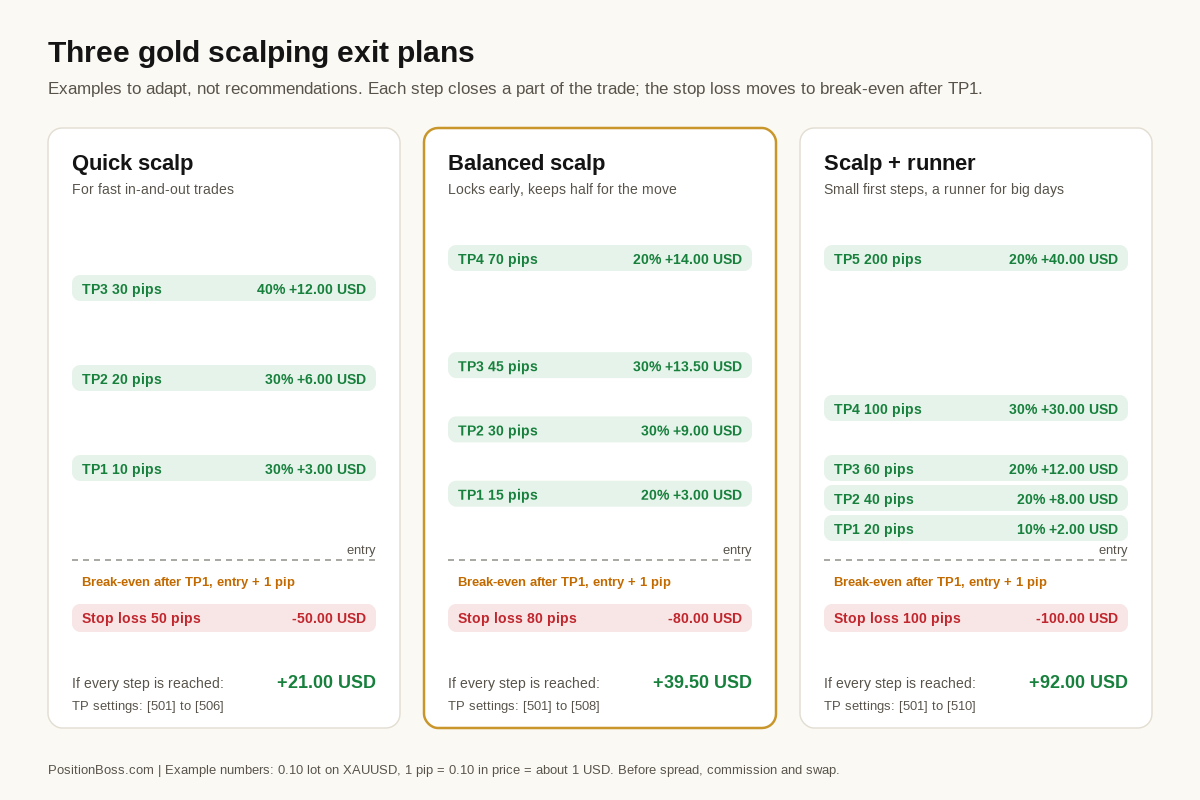
Quick scalp
For fast in-and-out trades in quieter hours, or when you only expect a short move.
| Step | Distance | Closes | 0.10 lot books |
|---|---|---|---|
| TP1 | 10 pips | 30% (0.03 lot) | +3.00 USD |
| TP2 | 20 pips | 30% (0.03 lot) | +6.00 USD |
| TP3 | 30 pips | 40% (0.04 lot) | +12.00 USD |
| Stop loss | 50 pips | all | −50.00 USD |
Break-even after TP1, entry + 1 pip. If every step is reached: +21.00 USD. If only TP1 is reached and the rest closes at break-even: +3.00 USD plus about 0.70 USD.
Balanced scalp
Locks profit early but keeps half of the trade for the move. A good default for the London session.
| Step | Distance | Closes | 0.10 lot books |
|---|---|---|---|
| TP1 | 15 pips | 20% (0.02 lot) | +3.00 USD |
| TP2 | 30 pips | 30% (0.03 lot) | +9.00 USD |
| TP3 | 45 pips | 30% (0.03 lot) | +13.50 USD |
| TP4 | 70 pips | 20% (0.02 lot) | +14.00 USD |
| Stop loss | 80 pips | all | −80.00 USD |
Break-even after TP1, entry + 1 pip. If every step is reached: +39.50 USD.
Scalp + runner
Small first steps for safety, and a runner for the days gold really moves. Its step distances (20, 40, 60, 100 and 200 pips) are also Gold Position Manager's default distances.
| Step | Distance | Closes | 0.10 lot books |
|---|---|---|---|
| TP1 | 20 pips | 10% (0.01 lot) | +2.00 USD |
| TP2 | 40 pips | 20% (0.02 lot) | +8.00 USD |
| TP3 | 60 pips | 20% (0.02 lot) | +12.00 USD |
| TP4 | 100 pips | 30% (0.03 lot) | +30.00 USD |
| TP5 | 200 pips | 20% (0.02 lot) | +40.00 USD |
| Stop loss | 100 pips | all | −100.00 USD |
Break-even after TP1, entry + 1 pip. If every step is reached: +92.00 USD. Most days the runner does not reach 200 pips, and that is fine: the plan is built so the first steps already pay for the trade.
All three are examples to show the structure, not recommendations. Fit the numbers to your entry method, your broker's costs and gold's current movement, and test them before you use real money.
Check that your lot can be split
Partial closes need a volume your broker can close. Most brokers accept 0.01 lot as the smallest volume and 0.01 as the step. So:
| Trade size | Quick scalp (30 / 30 / 40%) | Scalp + runner (10 / 20 / 20 / 30 / 20%) |
|---|---|---|
| 0.03 lot | 0.01 / 0.01 / 0.01 (not exact: 0.009 / 0.009 / 0.012) | not possible: 10% is 0.003 lot |
| 0.10 lot | 0.03 / 0.03 / 0.04 | 0.01 / 0.02 / 0.02 / 0.03 / 0.02 |
| 0.20 lot | 0.06 / 0.06 / 0.08 | 0.02 / 0.04 / 0.04 / 0.06 / 0.04 |
With a small account, use fewer steps rather than tiny percentages. The plan should fit your lot, not the other way round. Check your broker's minimum volume and volume step in the symbol specification in MT5. Our gold lot size calculator helps you find the lot that fits your risk first.
How to test a plan before you trust it
- Write it down with every number: stop loss, steps, percentages, break-even trigger and buffer.
- Use it unchanged for 20 trades on a demo account. One trade tells you nothing.
- Count how many trades reached TP1, how many were stopped at break-even, and how many hit the full stop loss.
- Change one thing at a time, for example break-even after TP2 instead of TP1, and test again.
The hard part is following the plan exactly on all 20 trades. By hand, most scalpers skip steps when the market is fast, and then the test measures their mood instead of the plan.
Running these plans with Gold Position Manager
Gold Position Manager carries out any of these plans on every trade you open, from the panel, the MT5 order window or the phone app:
- Stop loss: setting [401]. Steps 1 to 5: distance and % in [501] to [510]; steps 6 to 10 in [601] to [610]. A step with 0% is not used, and together the steps may close 100% or less.
- Break-even: [701] chooses after TP1, TP2, TP3, a step number ([702]) or a profit distance ([703]); [704] is the buffer; [705] can also cover commission and swap.
- If your lot cannot be split exactly, the panel says LOT CANNOT BE SPLIT EXACTLY and lets you choose KEEP PAUSED or SPLIT CLOSEST, instead of guessing.
- [511] closes everything still open at the last step, if you want no runner left.
- The PLAN tab shows the whole plan in plain words, and the free demo on MQL5 lets you watch it work on gold history in the Strategy Tester.
More about the tool for scalpers: gold scalping trade manager for MT5.
Questions
What is a good take profit for gold scalping?
There is no single number, but the first target should be at least three to five times your total costs per trade (spread plus commission). On most gold accounts that means a first step of 10 pips or more, followed by further steps every 10 to 30 pips.
Should I move my stop loss to break-even after TP1 or TP2?
After TP1 protects early but is stopped out more often by normal noise; after TP2 gives the trade room but gives back more when it turns. Test both on 20 demo trades and compare.
How many partial take-profit steps should a scalper use?
Usually three to five. More steps need a bigger lot: with a 0.01 minimum lot, five steps need at least 0.10 lot to split cleanly.
Is it better to close everything at one target?
One target earns more on the trades that reach it and nothing on the trades that turn just before it. Steps earn less on perfect trades and much more on the many trades that move in your favour and then pull back. Which is better depends on your entries.
This guide is education, not financial advice. The plans are examples to explain the structure; they are not recommendations and they do not predict any result. Spread, commission and slippage change real results. Trading gold carries a high risk of loss.