Key points
- Lots = risk ÷ (stop distance × contract size × rate into your account currency).
- "$10 a pip per lot" is only true when the profit is paid in your account currency and the contract is 100,000 units, as on EURUSD with a USD account.
- Measure the stop from your real entry price, and count spread and commission, or a 1% risk becomes 1.04% or more.
- Round down to the volume step, then check the minimum lot and your free margin.
How to calculate lot size in forex: the formula
To calculate lot size, divide the money you are willing to lose by what one lot loses at your stop: lots = risk ÷ (stop distance × contract size × exchange rate into your account currency). Round the result down to your broker's volume step and check that it fits the minimum lot.
This is MT5's own profit formula turned around. The MQL5 documentation gives the profit of a forex or CFD trade as price change × contract size × lots, in the symbol's profit currency. Solve that for lots at your stop, and you have your position size.
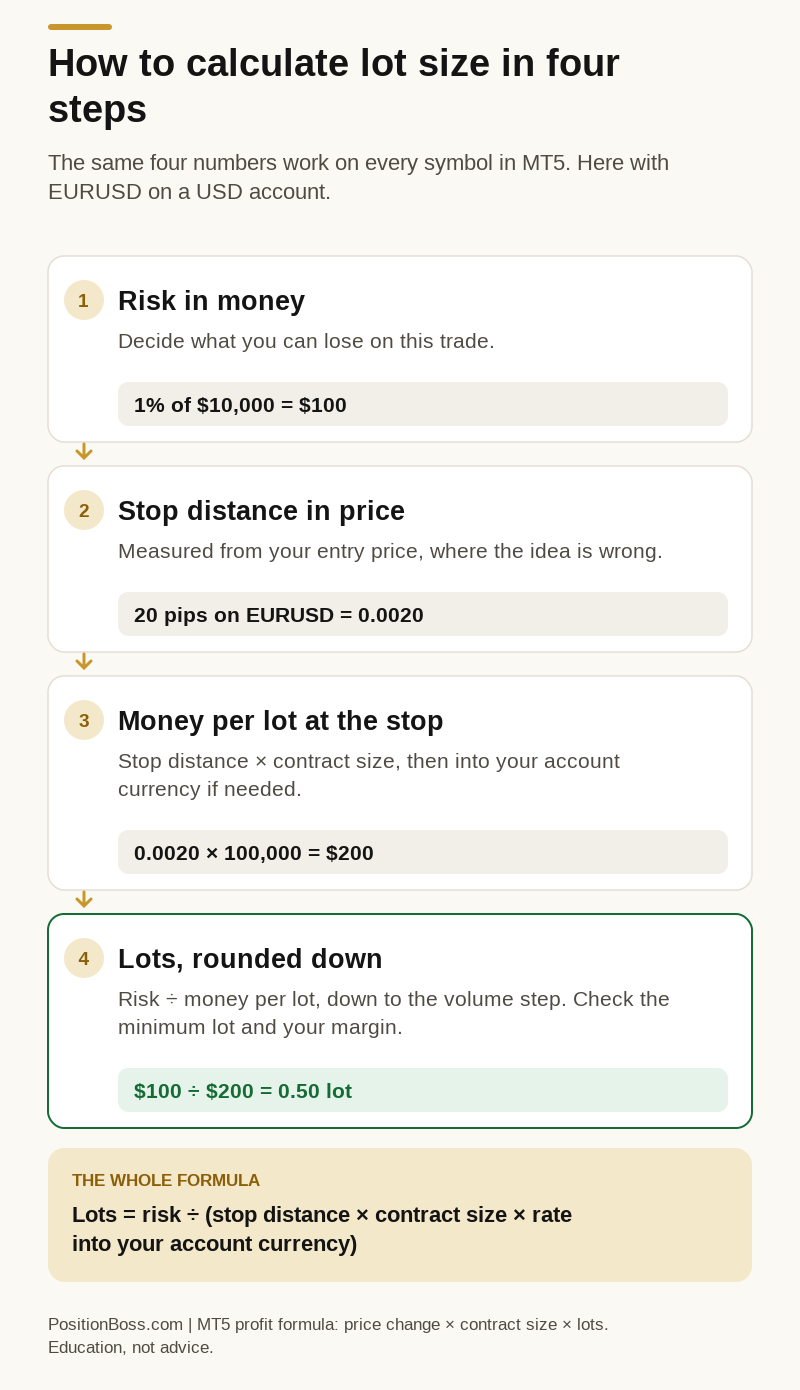
The four numbers, and where to find them in MT5
- Risk in money. A percentage of your account, for example 1% of $10,000 = $100. Decide whether you take it from your balance or your equity; with open trades, the two differ.
- Stop distance in price. The gap between your entry and your stop loss, as a price: 20 pips on EURUSD is 0.0020. Put the stop where your trade idea is wrong first, then size the lot; never move the stop to fit a lot size.
- Contract size. Press Ctrl+M for Market Watch, right-click the symbol and choose Specification. A standard forex lot is usually 100,000 units of the first currency, gold is usually 100 ounces, and indices differ by broker.
- Exchange rate. Only needed when the symbol pays profit in another currency than your account. The Specification window shows the profit currency.
Pip value: why "$10 a pip" is only sometimes true
One pip on 1.00 lot is the pip size times the contract size, in the profit currency. On EURUSD that is 0.0001 × 100,000 = $10, and with a USD account no conversion is needed. Change the pair or the account currency, and the number changes.
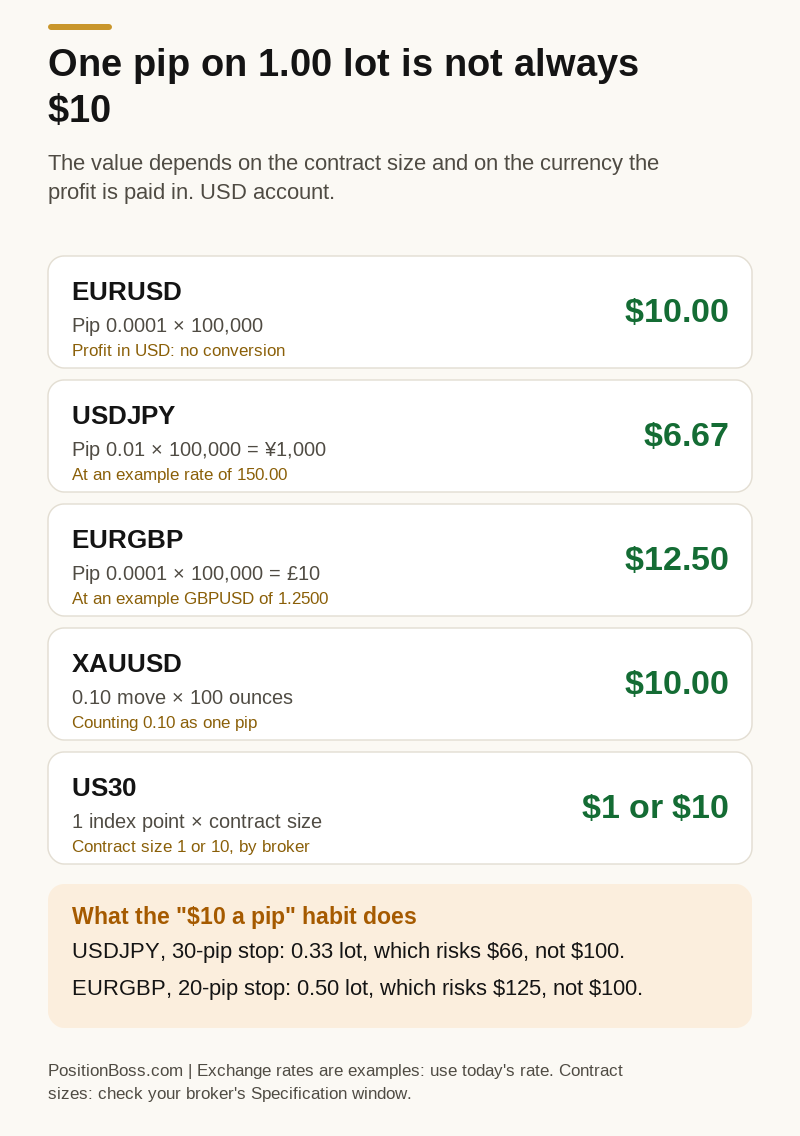
For yen pairs a pip is 0.01, the second decimal, so one pip on 1.00 lot of USDJPY is ¥1,000. At an example rate of 150.00, that is about $6.67. On EURGBP the profit is paid in pounds: £10 per pip, which is $12.50 if GBPUSD is 1.2500.
Worked examples on a $10,000 account
Every example risks $100 (1%) on a USD account, and rounds down to the 0.01 lot step. You can check each line with a calculator.
| Symbol | Stop | Money per lot at the stop | Lots |
|---|---|---|---|
| EURUSD | 20 pips (0.0020) | 0.0020 × 100,000 = $200 | 0.50 |
| USDJPY at 150.00 | 30 pips (0.30) | 0.30 × 100,000 = ¥30,000 = $200 | 0.50 |
| EURGBP, GBPUSD at 1.2500 | 20 pips (0.0020) | 0.0020 × 100,000 = £200 = $250 | 0.40 |
| XAUUSD, 100 oz | 80 pips ($8.00) | 8.00 × 100 = $800 | 0.12 (0.125) |
| US30, contract size 1 | 120 index points | 120 × 1 = $120 | 0.83 (0.833) |
| US30, contract size 10 | 120 index points | 120 × 10 = $1,200 | 0.08 (0.083) |
Now apply the "$10 a pip" habit to the same trades. On USDJPY it gives 100 ÷ (30 × $10) = 0.33 lot, which really risks $66. On EURGBP it gives 0.50 lot, which really risks $125: a quarter more than planned on every trade.
Gold (XAUUSD)
With the common 100-ounce contract, every $1.00 move is $100 per lot, so an $8.00 stop costs $800 per lot. Traders count gold pips in different ways; we count 0.10 as one pip, so this stop is 80 pips. Our XAUUSD pip value guide and gold lot size calculator cover gold in more depth.
Indices (US30)
Index contract sizes are set by each broker. In November 2026, Tickmill listed a US30 contract size of 1 and Eightcap listed 10, so the same 120-point stop needs 0.83 lot at one and 0.08 lot at the other. Read your own Specification window before your first index trade.
When your account is not in US dollars
Convert the money per lot into your account currency. With a EUR account, EURUSD at an example rate of 1.0800 and a 20-pip stop, one lot loses $200, which is about €185.19. A €100 risk then buys exactly 0.54 lot.
Points, pips and digits
MT5 counts many distances in points, and a point is simply the smallest price step of the symbol. A 5-digit EURUSD and a 3-digit USDJPY both have 10 points in a pip. Gold and indices are where it goes wrong.
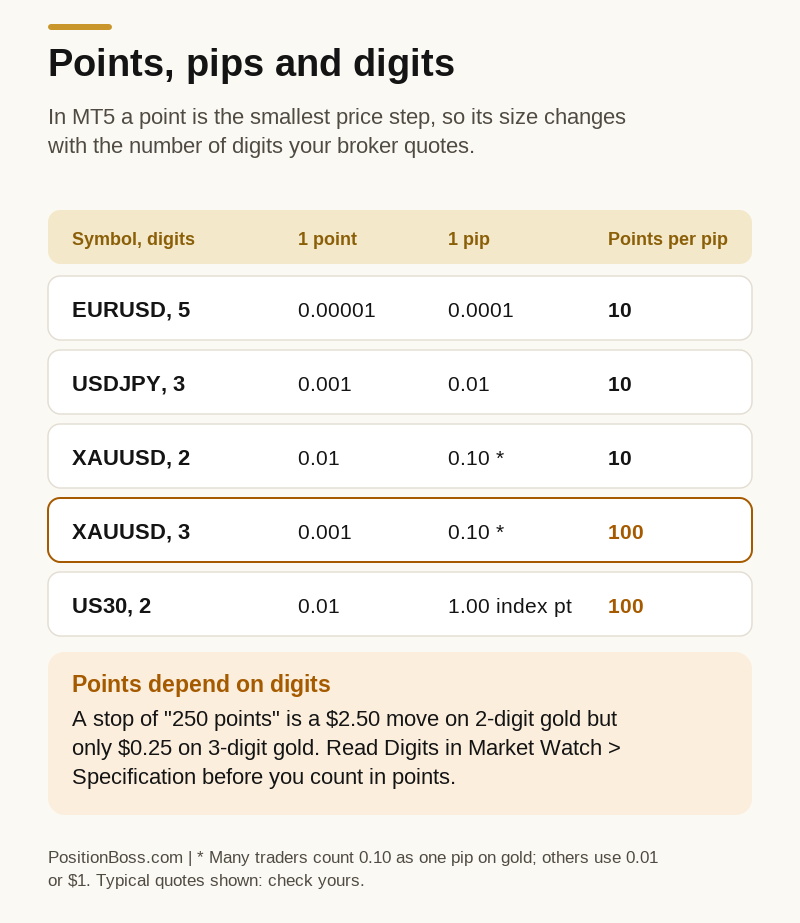
On a 2-digit gold quote, 80 pips are 800 points; on a 3-digit quote, the same stop is 8,000 points. On a US30 quote with two decimals, a 120-point stop in trader talk is 12,000 points in MT5. Type the wrong one into a calculator and the lot size is off by ten or a hundred times.
Risk after costs: spread and commission
Spread. MT5 charts of forex and CFD symbols show the Bid, but a buy fills at the Ask. Say EURUSD shows 1.08500 with an Ask of 1.08508, and you put the stop at 1.08300, 20 pips below the chart price. From your real entry it is 20.8 pips away, so the right size is 0.48 lot, and 0.50 lot would lose $104.
Commission. If your broker charges $7.00 per lot for the round trip, one lot at the 20-pip stop loses $200 + $7 = $207. That gives 0.48 lot and a real risk of $99.36. Sized without the commission, 0.50 lot would lose $103.50.
Swap, slippage and gaps can add more, and none of them can be known exactly in advance. That is why careful traders size from the money they can afford to lose, not from the money they hope to lose.
Before you click: minimum lot, volume step and margin
- Round down, never up. 0.125 lot becomes 0.12, not 0.13: rounding up would risk $104 instead of $100 on the gold example.
- Minimum and maximum lot. If the size is below your broker's Minimal volume, the trade does not fit your risk; skip it rather than moving the stop. Above the maximum, it must be split into several orders.
- Volume step. The examples here use a 0.01 step. If your index symbol steps in 0.1, 0.83 lot is not allowed and becomes 0.8.
- Margin. The size must also fit your free margin. MT5's forex formula is lots × contract size ÷ leverage: 0.50 lot of EURUSD at 1:100 needs €500, about $540 at an Ask of 1.0800.
Position size calculator: by hand, online or on the chart
Doing it by hand once is the best way to understand it. After that, the question is how fast and how safely you can do it on every trade.
| Method | How it works | Watch out for |
|---|---|---|
| By hand | Specification window, the formula and a calculator | Typos, the wrong pip size, a missed conversion |
| Online position size calculator | Type the account, risk, stop and pair | It may not know your broker's contract size, digits or commission; you still type the lot into MT5 |
| On-chart tool in MT5 | Drag the stop line; the lot comes from your broker's own symbol data | Check its settings once, such as risk % and whether the spread is counted |
For a swing trade placed once a day, the manual method costs a minute and works well. For intraday trading, the time spent on a calculator is time the price keeps moving, and a typed lot is one more place for a typo.
We built Trade Manager, an MT5 panel with a free version, to do this on the chart. You drag the stop line, and the panel sizes the lot from your risk in % or money, using the contract details MT5 reports for that symbol and converting them to your account currency, then rounds down to the volume step. It can add the spread to the stop distance, and its Costs view shows the risk before and after commission.
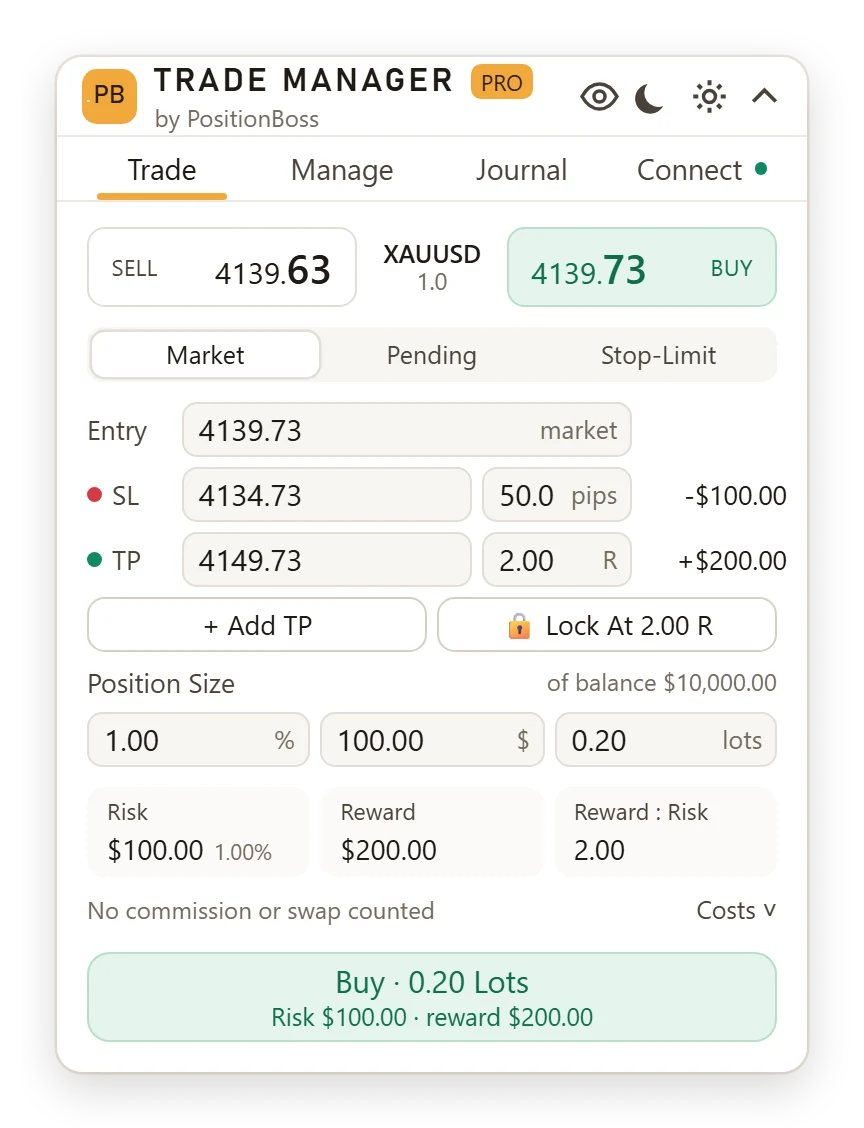
You can get the free version, or read how lot sizing fits into the rest of a trade in our complete guide to MT5 trade management.
Summary
To calculate lot size on any MT5 symbol, divide your risk in money by the stop distance times the contract size, converted into your account currency. Measure the stop from your real entry, include commission, round down to the volume step, and check the minimum lot and your margin. Never copy a lot size or a pip value from one symbol to another.
Questions
How do you calculate lot size in forex?
Divide your risk in money by the stop distance times the contract size, converted into your account currency. With $100 of risk, a 20-pip EURUSD stop and a USD account, that is 100 ÷ (0.0020 × 100,000) = 0.50 lot.
How much is one pip worth on 1.00 lot?
On pairs that pay profit in your account currency with a 100,000 contract, such as EURUSD with a USD account, it is $10. On other pairs it depends on the exchange rate: USDJPY pays ¥1,000 per pip, about $6.67 when USDJPY is 150.00.
How do I calculate lot size for gold (XAUUSD)?
With the common 100-ounce contract, every $1.00 move is $100 per lot. Divide your risk by the stop in dollars times 100: $100 of risk with an $8.00 stop is 0.125, rounded down to 0.12 lot.
How do I calculate lot size for US30?
Find the contract size in your broker's Specification window, because it differs between brokers. With a contract size of 1, a 120-point stop costs $120 per lot; with 10, it costs $1,200.
Should I round my lot size up or down?
Always down, to your broker's volume step. Rounding up puts more than your planned risk on the trade, every single time.
Sources
- MQL5 Reference: profit and margin formulas for each calculation mode
- MetaTrader 5 Help: symbol specification (contract size, digits, minimal volume, volume step)
- MetaTrader 5 Help: forex margin and conversion into the account currency
- MetaTrader 5 Help: Bid and Ask prices and stop loss triggers
- IG: what a pip is, including yen pairs
- CMC Markets: pips in forex
- Tickmill: EURUSD, USDJPY (contract size 100,000) and US30 (contract size 1)
- Eightcap: US30 (contract size 10)
- TNFX: XAUUSD (100 ounces, two digits)
This guide is education, not financial advice. Trading forex, gold and indices with leverage carries a high risk of losing money. Exchange rates and contract sizes here are examples; your broker's figures and fills may differ, and a stop can fill worse than its price in fast markets.