Key points
- A trailing stop moves your stop loss up as the price moves your way, and never moves it back.
- MT5 has one built in. It runs inside MT5 on your computer, so it stops working when MT5 is closed.
- There are five common ways to trail a stop. None of them wins every time: each fits a different kind of market.
- The biggest mistake is a trail that is too tight. On our example trade, a $1.00 trail kept 0.2R; a $3.00 trail kept 2R.
What is a trailing stop in MT5?
A trailing stop in MT5 is a stop loss that follows the price. Once your trade is in profit by the distance you choose, MT5 moves the stop behind the price and keeps moving it as the price goes your way. It never moves back, so every step locks in more profit.
Think of a zip tie: it pulls tighter and tighter, but it never loosens. A normal stop loss sits still. A trailing stop climbs with your trade, so a winner has a much smaller chance of turning into a loser.
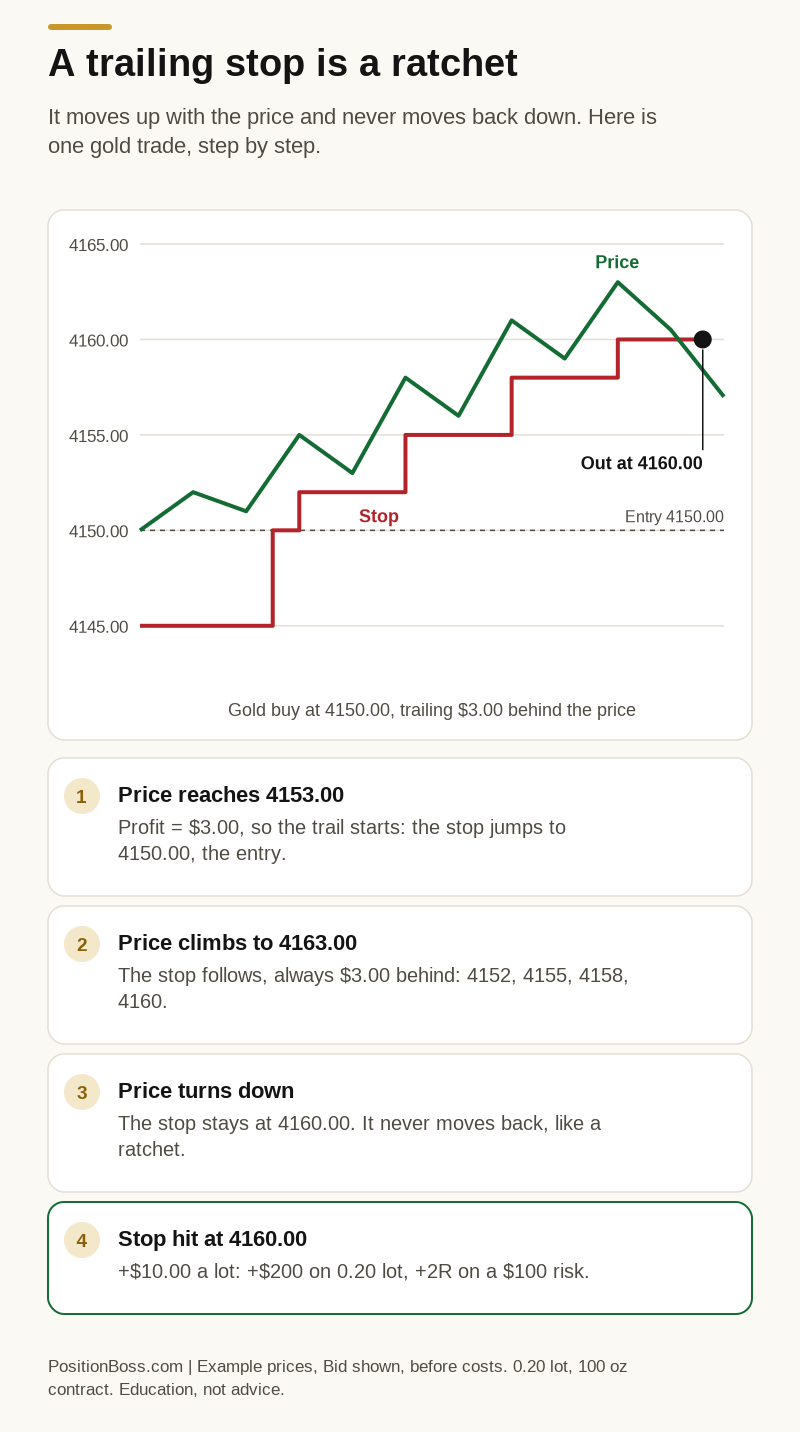
How to set a trailing stop in MT5 (20 seconds)
- Press Ctrl+T to open the Toolbox and click the Trade tab.
- Right-click your open trade and choose Trailing Stop.
- Pick the distance you want between the price and your stop.
- To switch it off later, choose None in the same menu. Delete All switches off every trailing stop at once.
That is it. MT5 waits until your profit equals the distance you picked, places the stop that far behind the price, and moves it up as the price rises.
Three things the menu does not tell you
- It lives on your computer. MetaTrader 5's help says the trailing stop runs in the platform, not at your broker. Close MT5 and it stops; only the last stop it set stays in place. To keep it running, leave MT5 on, or use a VPS (see do MT5 EAs work when your computer is off?).
- It is not instant. It can move the stop at most once every 10 seconds per trade.
- One per trade. Each open trade can have only one trailing stop.
MT5 counts the trailing distance in points, the smallest price step. On a 2-digit gold quote, $3.00 is 300 points (3,000 on a 3-digit quote), and on a 5-digit EURUSD, 20 pips is 200 points. Check the digits before you pick a distance.
The 5 ways to trail a stop
All five examples use the same gold trade: buy 0.20 lot at 4150.00 with the first stop at 4145.00. That stop is $5.00 away, which is a $100 risk, our 1R ("one risk unit").
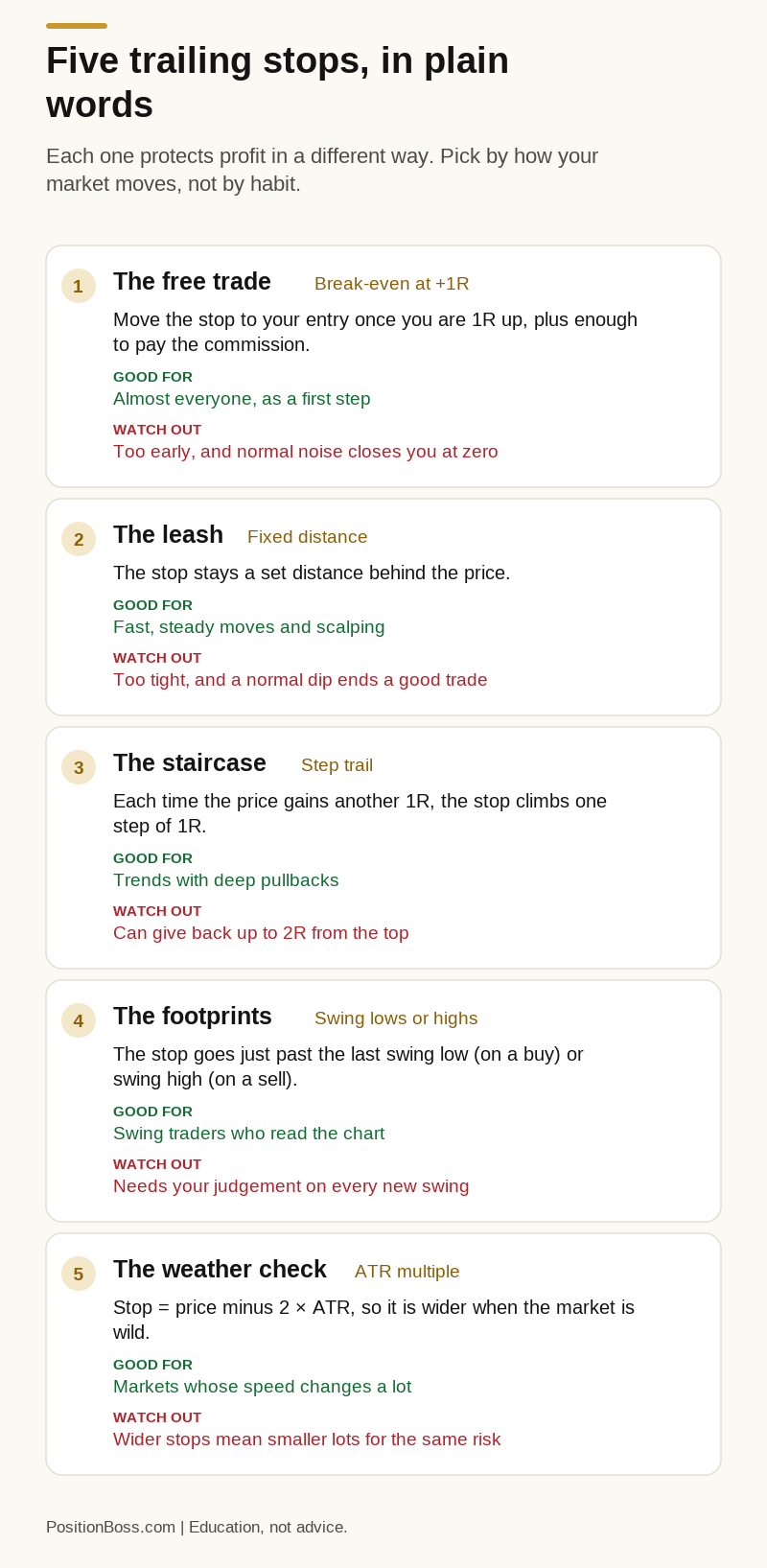
1. The free trade: break-even at +1R
When the price reaches 4155.00, you are 1R up. Move the stop to the entry, and the worst case is now about zero: a "free trade". Add a few cents for the commission: at $7.00 per lot for the round trip, 0.20 lot pays $1.40, so the stop goes to 4150.07 instead of 4150.00.
Watch the timing. Move it too early and an ordinary wiggle closes you at zero, just before the price runs. Our break-even guide for gold covers the timing in detail.
2. The leash: a fixed distance
This is MT5's built-in trailing stop. With a $3.00 leash, the stop jumps to 4150.00 when the price hits 4153.00, then stays $3.00 behind every new high. In the chart above, it closed the trade at 4160.00 for +$200.
The secret is the length of the leash. Make it longer than the normal dips of your market, or every small pullback will pull you out.
3. The staircase: a step trail
Here the stop climbs in whole steps. At +1R (4155.00) it moves to the entry; at +2R (4160.00) it moves to +1R (4155.00); at +3R it moves to +2R, and so on. It gives the trade room to breathe in trends that dip and climb.
MT5 has no step trail built in. You move the stop by hand each time a step is reached, by dragging the stop line on the chart.
4. The footprints: swing lows and highs
Each time a buy makes a new high, move the stop just under the last swing low, the last dip the price bounced from. In our example the buffer is $0.30, so a swing low at 4156.00 puts the stop at 4155.70. On a sell, use the swing highs instead.
This follows the market's own footprints, so it suits traders who read the chart. It also means a judgement call on every new swing.
5. The weather check: an ATR trail
ATR (Average True Range) measures how wildly the price is moving. Add it from Insert > Indicators > Oscillators > Average True Range, then keep the stop a set number of ATRs behind the price. Say ATR reads 2.40: with 2 × ATR, the stop at a price of 4161.00 sits at 4156.20.
When the market gets wild, the stop moves further away by itself; when it calms down, the stop moves closer. Some traders use a moving average the same way, with the stop just under the line.
Same trade, three trailing stops
Here is the same gold buy on two made-up price paths. On each, we let three trails run to the end and counted what they kept.
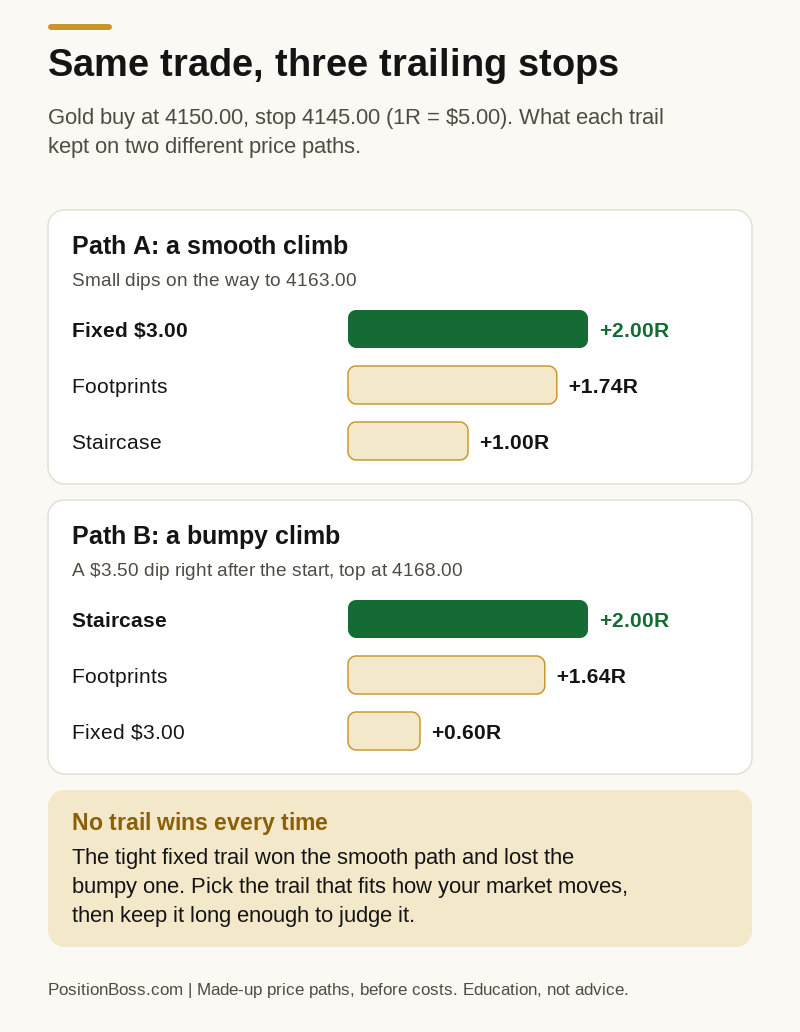
On the smooth path, the $3.00 leash won with +2.00R. On the bumpy path, a $3.50 dip right after the start knocked it out at +0.60R, while the staircase rode the trend to +2.00R. The footprints came second both times, at +1.74R and +1.64R.
And the too-tight trail? With a $1.00 leash on the smooth path, the first small dip closed the trade at 4151.00 for +$20, which is just 0.2R. The same entry kept ten times more with a $3.00 leash.
Five mistakes that turn a trailing stop against you
- A leash that is too short. If your distance is smaller than the normal dips, you will be stopped out of good trades again and again.
- Starting too soon. A trail that starts before the trade has room will often close it near zero.
- Closing MT5. MT5's trailing stop and most trade-management tools only work while MT5 is open.
- Pips and points mixed up. 30 points on gold is not 30 pips. Check the digits first.
- Moving the stop back. A trailing stop only works if it never moves against you. Widening it "just this once" turns it back into a hope.
Trailing a stop by hand or with a trade manager
| Method | MT5 on its own | With Trade Manager PRO |
|---|---|---|
| Break-even | By hand: drag the stop when you see +1R | Automatic at the profit you set, and it can pay the commission too |
| Fixed distance | Built in, set on each trade by hand | Automatic on every trade of that chart's symbol |
| Staircase | By hand, one trade at a time | By hand, but Move Stop moves the stops of many trades at once |
| Footprints | By hand | By hand (not automatic) |
| ATR | By hand, reading the ATR indicator | By hand (not automatic) |
Whichever way you trail, the stop that is already at your broker stays in place if MT5 closes. Only the moving part needs MT5 to be running.
Where Trade Manager fits
We built Trade Manager for MT5, and its PRO version handles the first two methods for you. Set Breakeven At and Trailing Stop once, and every trade on that chart's symbol follows the rule. You choose whether that means only the trades placed with the panel, or every trade on the symbol, including ones you open on your phone.
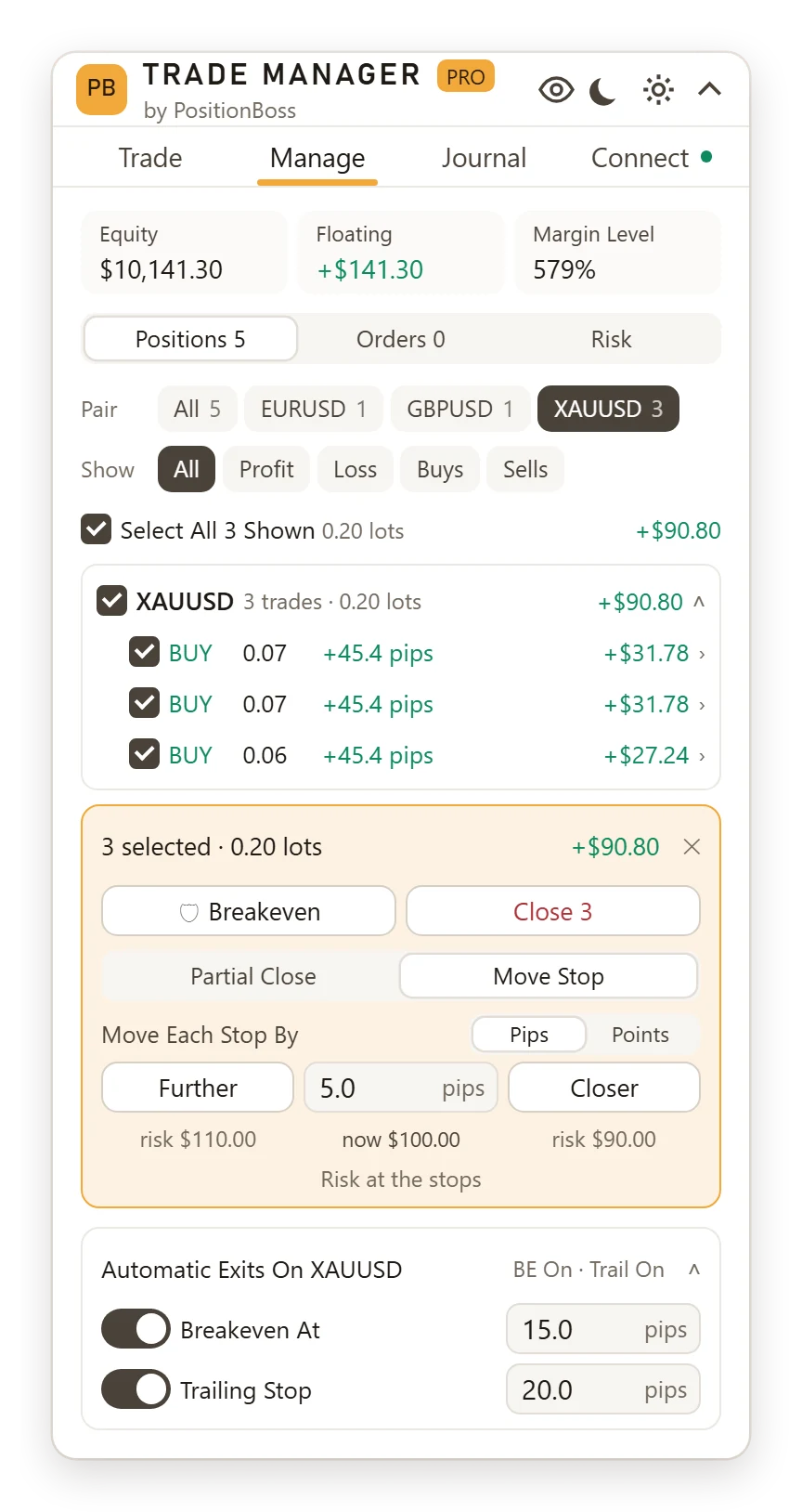
For the staircase, Move Stop shifts the stops of all your ticked trades by the same distance, and shows the risk before and after. Like MT5's own trailing stop, the automatic exits need MT5 to stay open. You can see the PRO options or read how it fits in our complete guide to MT5 trade management.
Summary
A trailing stop in MT5 moves your stop up as the price moves your way and never moves it back. Set the built-in one from the Trade tab in seconds, keep MT5 running, and give the leash more room than your market's normal dips. Then pick the method that fits how your market moves: the free trade, the leash, the staircase, the footprints or the weather check.
Questions
What is a trailing stop in MT5?
It is a stop loss that follows the price. Once your profit reaches the distance you choose, MT5 moves the stop behind the price and keeps moving it your way, never back.
How do I set a trailing stop in MT5?
Open the Trade tab (Ctrl+T), right-click your trade, choose Trailing Stop and pick a distance. Choose None in the same menu to switch it off.
Does the MT5 trailing stop work when my computer is off?
No. It runs in MT5 on your computer, so it stops when MT5 closes; only the last stop it set stays at your broker. Keep MT5 open or run it on a VPS.
What is a good trailing stop distance for gold?
There is no single number: it should be larger than gold's normal dips on your timeframe, which change from day to day. One common approach is to base it on ATR, for example 2 × ATR, so it widens when the market is wild.
When should I move my stop to break-even?
A common rule is at +1R, once the trade has made as much as you risked. Add a few cents or points for the commission so a break-even close really costs nothing.
Sources
- MetaTrader 5 Help: trailing stop (where to set it, when it starts, 10 seconds, runs in the platform)
- MetaTrader 5 Help: Average True Range
- MetaTrader 5 Help: keyboard shortcuts (Ctrl+T)
This guide is education, not financial advice. The price paths are made up for teaching. A stop can fill worse than its price in fast markets or over a gap, and trading gold, forex and indices with leverage carries a high risk of losing money.